Cuivre River State Park
The “Ozarks of the North”—rugged hills, limestone bluffs, and a swimming lake an hour from St. Louis.
Table of Contents
- The Basics
- Getting There
- Lake Lincoln
- Rivers & Creeks
- Campgrounds
- Trails
- Naturalist Programs
- Wildlife
- Park Rules & Good Manners
- Key Contacts
The Basics
Cuivre River State Park covers more than 6,400 acres in the Lincoln Hills of northeastern Missouri—an unusually rugged landscape of forested hills, native prairie, limestone bluffs, and clear creeks that feels more like the Ozarks than the flat farmland around it. It’s one of Missouri’s largest state parks, built in the 1930s by the Civilian Conservation Corps and the WPA.
| Detail | Information |
|---|---|
| Address | 678 State Route 147, Troy, MO 63379 |
| Park office | (636) 528-7247 |
| Naturalist programs | (636) 528-7427 |
| Size | 6,400+ acres |
| Lake | Lake Lincoln, 55 acres |
| Day-use hours | 6 a.m.–10 p.m. |
| Entrance fee | None (Missouri State Parks are free) |
| Emergency | 911 |
No entrance fee, but camping isn’t free. Our sites are booked and paid ✅. Fishing still requires a Missouri permit for most adults—see Fishing.
Getting There
From Troy, MO, take State Route 47 north about 3 miles to State Route 147, then turn east on Route 147 and follow it about 3 miles to the park entrance.
Coming from Columbia, it’s roughly 90 miles / 1.5 hours via I-70 east to Wentzville, then US-61 north to Troy. The full route, stops, and the last good grocery run are in The Drive from Columbia.
Lake Lincoln
The heart of the park for our group. A 55-acre lake with:
- A real swimming beach at the north end, with a change house and restrooms. Open seasonally, 8 a.m.–8 p.m. Swimming is allowed only in the beach area.
- Calm paddling water. Only electric trolling motors are allowed—no gas motors—so the lake stays quiet and flat. Bring your own kayaks and canoes.
- Fishing for largemouth bass, channel catfish, bluegill, sunfish, and crappie.
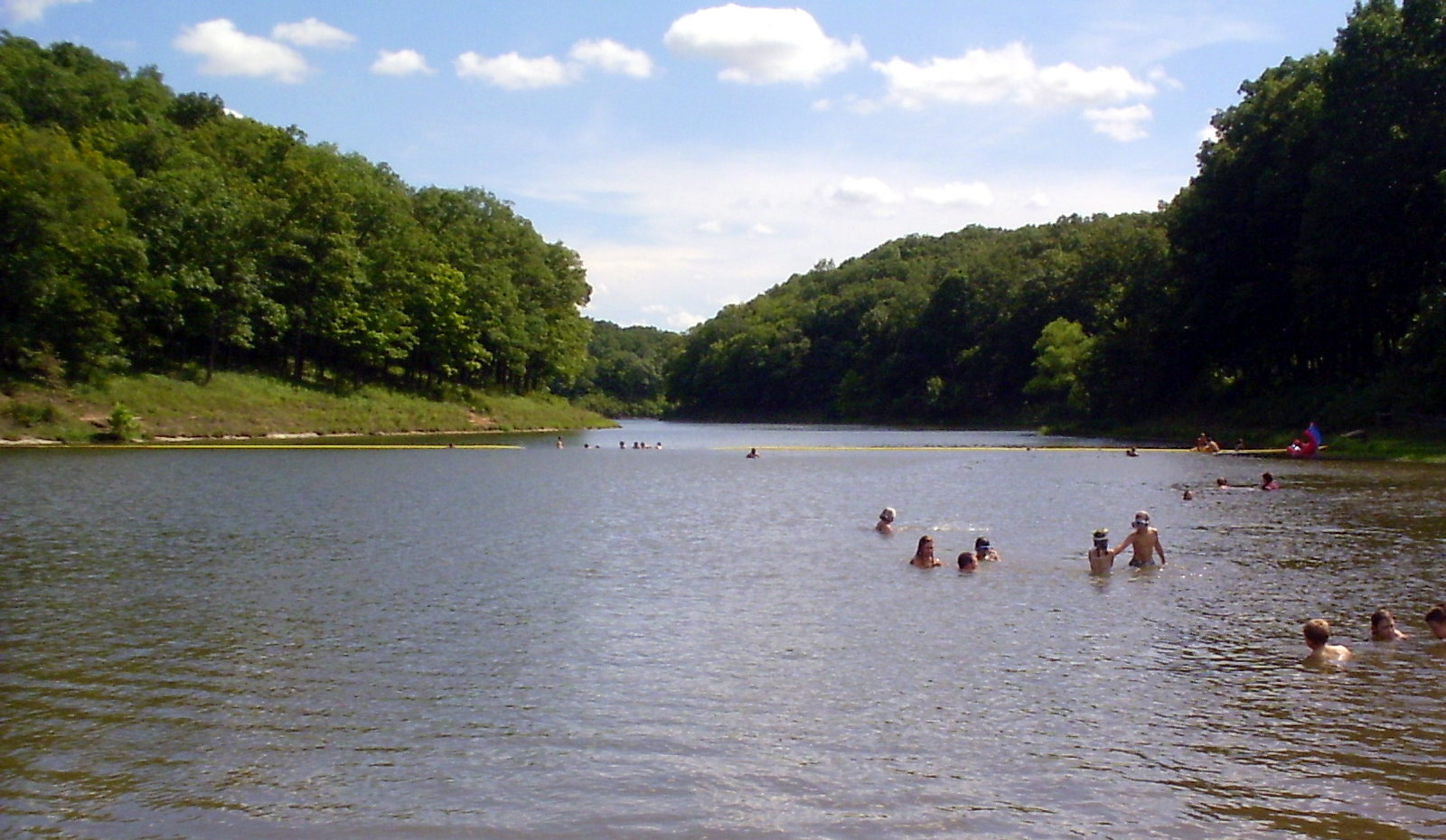 Lake Lincoln swimming area. Photo: Wikimedia Commons (CC BY-SA).
For paddling details see Kayaking & Canoeing; for the beach and water safety see Swimming & the Beach.
Rivers & Creeks
Beyond the lake, the park is laced with moving water:
- Big Sugar Creek — a designated state natural area; clear, rocky, good for wading, exploring, and creek fishing.
- The Cuivre River — on the park’s edges; floatable by canoe, kayak, or tube in good water conditions.
Water levels swing with the weather—always check conditions at the office before a river float, especially after rain.
Campgrounds
The main campground has 68 sites in a mix of types:
| Site type | What you get |
|---|---|
| Basic | No hookups; tent or self-contained camper |
| Electric | Electric hookup (up to 50-amp on some sites) |
| Sewer / Electric / Water | Full hookups for campers/RVs |
Other camping areas include an equestrian campground, organized group camps (historic Camp Sherwood Forest and Camp Derricotte), backpack camping along the trails, and a special-use area.
Facilities: Hot showers and seasonal water are available April 15–October 31 (so we’re covered for July). Vault toilets stay open year-round. RVs up to about 65 feet can be accommodated on full-hookup sites.
Our two adjacent sites are booked for all four families—see Camp Setup for the layout.
Trails
The park has about 12 named trails ranging from short strolls to an 11-mile backpacking loop—roughly 45 miles of trail in all. Highlights for our group:
| Trail | Length | Best for | Notes |
|---|---|---|---|
| Lakeside Trail | Short loop | Families, kids | Easy walk around Lake Lincoln |
| Frenchman’s Bluff Trail | Short, blue blaze | Big payoff hikes | 120-ft limestone bluff with valley views |
| Blazing Star Trail | Loop, orange blaze | Wildflowers | Tallgrass prairie at Sherwood Prairie |
| Big Sugar Creek Trail | Moderate, blue blaze | Hikers | Keyhole Bluff overlook, wild area |
| Lone Spring Trail | Backpacking, yellow | Older kids/adults | Northwoods Wild Area, crosses Big Sugar Creek |
| Cuivre River Trail | ~7 mi (N & S loops) | Backpackers | From equestrian camp to Frenchman’s Bluff |
| Blackhawk Point Trail | 5.75 mi | Mountain biking | Easy–intermediate |
| Old Schoolhouse Trail | 3.85 mi | Mountain biking | Intermediate; Lake Lincoln view |
Two trails—Blackhawk Point and Old Schoolhouse—are open to mountain bikes. See Hiking and Biking for picks by age and ability.
Naturalist Programs
From May through September, park naturalists run evening programs at the campground amphitheater (weather permitting), plus nature hikes and other interpretive programs. These are free, fun, and great for the kids—think night hikes, critter talks, and campfire programs. Call (636) 528-7427 or check the bulletin board at the campground for the week’s schedule when we arrive.
Wildlife
The park’s mix of forest, prairie, bluff, and water supports a lot of life: white-tailed deer, wild turkey, woodpeckers and songbirds, herons along the water, frogs and turtles in the creeks, and—at dusk—plenty of fireflies. See Wildlife & Nature for a kid-friendly spotting list.
Ticks, chiggers, and poison ivy are real in a Missouri summer. Wear repellent, do tick checks, and learn “leaves of three.” Details on the Camp Setup and Packing pages.
Park Rules & Good Manners
- Quiet hours: 10 p.m.–6 a.m.
- Pets: Welcome but must be leashed (10-foot max) and attended.
- Swimming: Only at the designated beach, during posted hours.
- Boating: Electric motors only on Lake Lincoln.
- Fires: In provided rings/grills only; follow any burn bans posted at the office.
- Firewood: Buy it locally or at the park—don’t haul firewood long distances (it spreads tree-killing pests). Don’t gather wood in the park.
- Leave No Trace: Pack out trash, stay on trails, don’t disturb wildlife or plants.
Key Contacts
| Contact | Number |
|---|---|
| Park office | (636) 528-7247 |
| Naturalist / programs | (636) 528-7427 |
| Missouri State Parks | mostateparks.com |
| Emergency | 911 |